
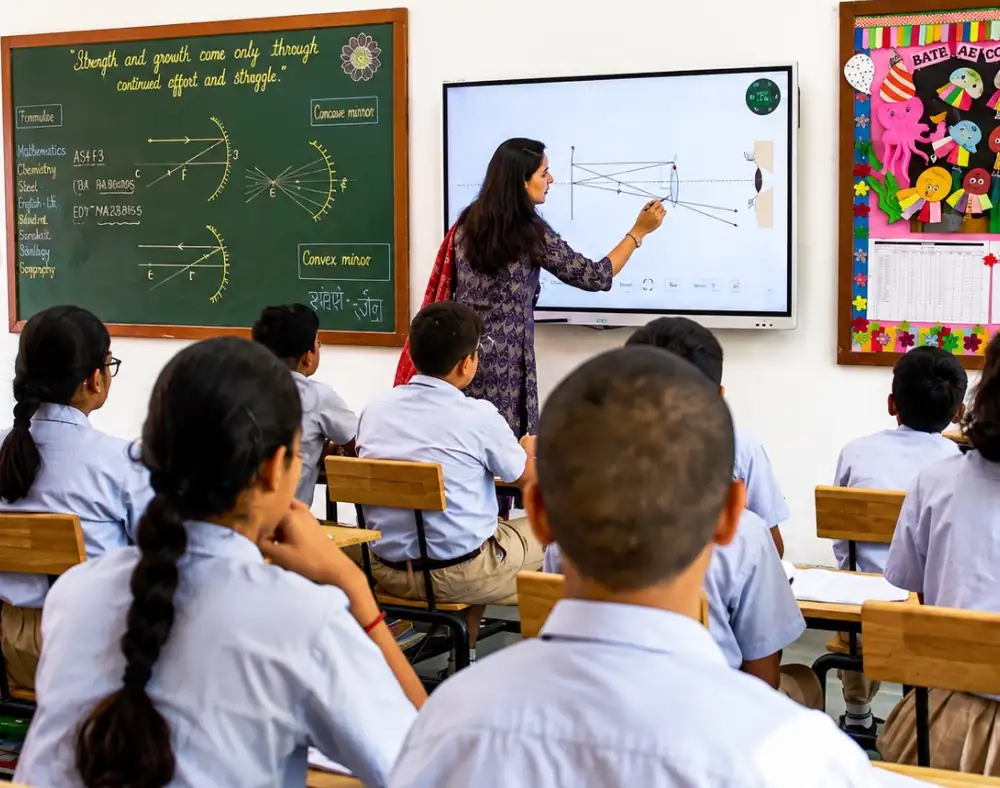
From Smart Classrooms to Smarter Learning
Today, technology has been democratised to
such an extent that even a child can find an answer to almost any question
within seconds. A search engine can explain a concept, a video can demonstrate
it, and an interactive simulation can bring an idea to life. Increasingly,
AI-based technologies too are reaching into every aspect of student life.
But access to information is not the same as understanding it.
This is where the integration of technology in curriculum becomes important. Technology in education is not simply about putting screens into classrooms or replacing textbooks with tablets. It is about using digital tools thoughtfully to make learning more interactive, visual, collaborative and connected to the world children already inhabit.
For parents exploring schools in Vadodara, this raises a useful question. It is not simply ‘how much technology does a school use?’ but ‘how does technology improve the way a child learns?’
That distinction matters. At Nalanda International School, we believe that technology-enabled learning should still begin with good teaching, thoughtful questions and an understanding of how children learn.
At its best, technology does not change the
purpose of education. It expands the possibilities within it.
Technology should serve the lesson, not become the lesson
A smartboard by itself does not make a classroom smarter. The value of technology lies in what it enables a teacher and a child to do differently. A science concept that is difficult to visualise can be explored through an animation. A historical event can be examined through a digital archive. A mathematical idea can be tested through an interactive simulation. The technology is the tool. The learning remains the purpose.
This is an important principle when
considering or evaluating technology
integration at the best school in Vadodara. Parents should look beyond
the number of devices or screens and ask how these tools are being used to
deepen understanding.
From consuming information to exploring ideas
Digital learning can easily become passive. Children can watch videos, scroll through content and click through activities without necessarily thinking deeply about what they see.
Used well, however, technology can move
learning in the opposite direction.
Instead of simply watching an experiment, students can investigate what happens when one of the variables changes. Instead of reading about a distant place, they can explore maps, images, and data. Instead of merely presenting an answer, they can create a digital presentation, animation, or visual explanation of their own.
The shift is subtle but important: from
consuming information to working with it.
That is also what can distinguish digital learning at Nalanda
International School Vadodara; the understanding that technology is
most useful when it becomes part of an active learning process rather than an
end in itself.
A classroom without four walls
Technology can also change the boundaries of the classroom. A geography lesson can extend beyond a textbook through satellite imagery and digital maps. A language lesson can introduce children to voices and perspectives from different parts of the world. A discussion about the environment can be connected to real-world information and global case studies.
This does not make the physical classroom less important. It gives teachers more ways to connect classroom learning with the wider world.
The teacher still matters most
There is a temptation to think that more technology means less dependence on teachers. In reality, meaningful digital learning requires strong teaching.
A teacher decides which resource is useful, which question is worth asking and when a screen should be put away. They help children distinguish reliable information from misinformation and encourage them to question what they encounter online.
Technology can provide possibilities. A
teacher provides context, judgement, and human connection. The relationship
between the two is therefore not about replacement. It is about making teaching
more responsive to the needs of today's learners.
Smart classrooms need smart learning design
A smart classroom can make lessons more visual and interactive. But the presence of technology does not automatically make a lesson engaging or effective.
Smart classroom learning begins with a clear learning objective. Technology is then introduced when it can help children reach that objective more effectively.
For example, an interactive model may help
explain a scientific process that is difficult to observe directly. A
collaborative digital activity may allow students to work together on a
problem. A visualisation may help turn an abstract mathematical idea into
something children can see and manipulate.
The question should always be: what can children understand, explore or create through this tool that they could not do as effectively otherwise?
That is a more useful way to think about top ICSE schools in Vadodara
with smart classrooms. The sophistication of the classroom matters less
than the quality of learning that takes place within it.
Digital literacy is more than knowing how to use a device
Being comfortable with technology is not the same as being digitally literate. Digital literacy education should help children understand how to navigate the digital world responsibly and thoughtfully. This includes knowing how to search for information, assess sources, communicate online, protect personal information and understand that not everything on a screen is necessarily true. These are increasingly important life skills.
Children need to become not just capable
users of technology, but discerning users of information.
Technology can make learning more active
One of the strongest possibilities offered by digital tools is the ability to turn children from observers into participants. A student can build a presentation rather than simply read one. Or collaborate with classmates on a shared project rather than complete every task individually. This connects naturally with active and experiential approaches to education. The technology provides another medium through which children can investigate, create and communicate.
This is where innovative teaching methods at top schools in Vadodara
can make a difference. Innovation does not necessarily mean using the newest
technology. It can mean finding a better way to help a child understand an
idea.
Personalisation without losing the human element
Children do not all learn in exactly the same way or at the same pace. Digital tools can offer diverse ways of approaching a concept and, in some settings, allow learning activities to be adapted to individual needs.
But personalisation does not mean placing every child in front of a separate screen. A technology-integrated ICSE curriculum can combine digital resources with discussion, collaboration, practical activity, reading, writing and teacher guidance. Variety matters because learning is richer when children encounter ideas in more than one way.
The goal is not more screen time. It is
better learning time.
Preparing children for a digital world
Schools are not simply preparing children for the next examination. They are also preparing them for a world in which technology will continue to shape how people work, communicate and solve problems.
That means children need more than technical familiarity. They need curiosity, critical thinking, creativity, communication, and the confidence to learn new tools as those tools evolve.
For parents looking at the best ICSE school in Vadodara for technology-based learning, this distinction is worth considering.
The goal is not to predict which technology
children will use ten years from now. It is to give them the habits of mind
that will help them adapt to whatever comes next.
The importance of balance
There is another side to the conversation that deserves equal attention: children also need time away from screens. Reading a physical book, solving a problem on paper, talking to a classmate, conducting a hands-on activity, playing outdoors and simply observing the world around them are all valuable forms of learning.
Technology should add to this range, not eliminate it.
For parents considering the best school in Vadodara for digital education, this balance is worth examining. A digitally capable school should also understand when digital tools are unnecessary.
The most effective technology-enabled
classrooms are not necessarily the ones where technology is used all the time.
They are the ones where teachers know when it adds value, and when another
approach is better.
What meaningful technology integration looks like
The real measure of technology integration is therefore not the sophistication of the equipment. It is what happens to the learning. Do children ask better questions? Can they explore ideas more independently? Do they have opportunities to create rather than simply consume?
These are just a few of the questions that offer a more useful way of understanding how digital learning at Nalanda International School Vadodara is more than simply counting devices or screens.
For a school following the ICSE curriculum,
technology can become another way of making concepts accessible, encouraging inquiry,
and connecting classroom learning with the world outside it.
The future classroom is not necessarily a more digital classroom
The future of education is sometimes imagined as a classroom filled with screens, artificial intelligence and increasingly sophisticated devices. But technology alone cannot define the classroom of the future.
Perhaps the more important change is the kind of learner the classroom prepares: one who knows how to find information, question it, connect ideas, create something new and keep learning when the answer is not immediately available. That is where technology has its greatest educational value.
The aim of a technology-integrated ICSE curriculum in Vadodara
should not be to make education more digital for its own sake. It should be to
make learning richer where digital tools genuinely add value — while preserving
the human conversations, practical experiences and curiosity that make
education meaningful in the first place.
FAQs
Technology integration means using digital tools as part of the learning process rather than treating technology as a separate subject or add-on. It can include interactive resources, digital research, multimedia content, collaborative platforms and creative digital projects, depending on the learning objective.
Parents should look beyond the technology available and understand how it is used. A good smart classroom should support clear learning objectives, encourage participation and help students understand concepts more effectively, while maintaining a balance with discussion, reading, practical activities and teacher interaction.
Technology can give children opportunities to research, evaluate information, communicate and create. Digital literacy also involves understanding online safety, recognising unreliable information, protecting personal data and using digital platforms responsibly.
Technology can support learning at different ages, but its role should change according to children's developmental needs. Younger learners may benefit from carefully selected visual and interactive resources, while older students can use digital tools for research, collaboration, analysis and creating more complex work.
So, what should parents look for in a technology-enabled school?
When comparing top schools in Vadodara for digital learning options, parents can look beyond the presence of smart classrooms and devices.
Ask how technology is used across subjects. Does it encourage children to investigate and create? Are students taught to evaluate digital information? Is technology balanced with reading, discussion, practical work, and outdoor activity? Do teachers use digital tools with a clear learning purpose?
These questions reveal much more than a list of gadgets.
At Nalanda International School, the role of technology is understood within a wider approach to education; one that values active participation, exploration, independent thinking and learning beyond rote memorisation.
Technology then becomes what it should be: A
means of making good learning possible in more ways.